Hrvoje Krizic

Research

Strong gravitational lensing and time-delay cosmography at the University of Geneva.

Current research

PhD Research

2025 - Present

Supervisors

Affiliation

  • University of Geneva
  • TDCOSMO Collaboration

Department of Theoretical Physics (DPT)

Strong Gravitational Lens Modeling for Time-Delay Cosmography

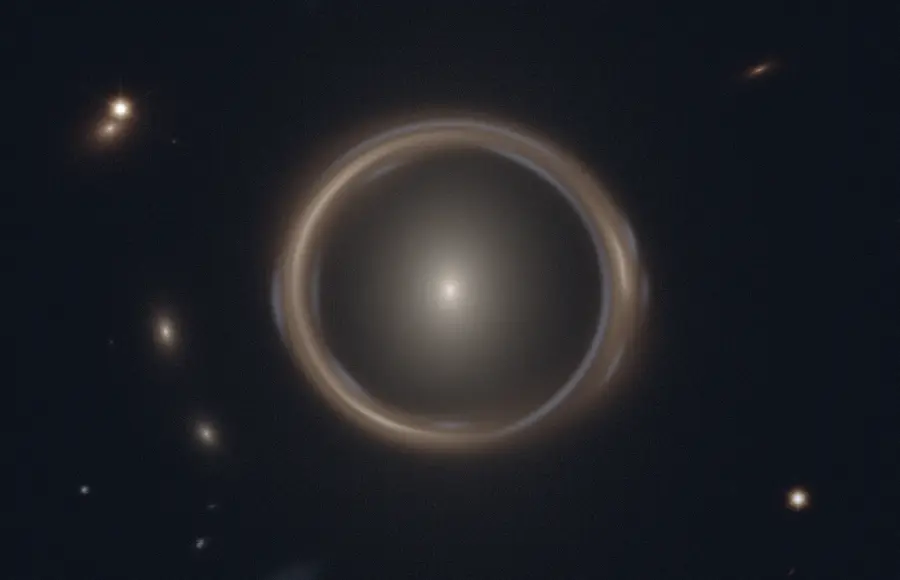
My PhD research focuses on automating the modeling of strong gravitational lenses while maintaining cosmography-grade precision. Strong gravitational lensing occurs when a massive foreground galaxy bends light from a distant quasar, creating multiple images of the same source. By measuring the time delays between these images, we can constrain the Hubble constant H₀.

Traditional lens modeling is time-intensive and requires significant manual effort. Within the TDCOSMO collaboration, I develop automated pipelines that can efficiently model large samples of lenses without sacrificing the accuracy needed for precision cosmology.

This work addresses the Hubble tension: the discrepancy between local measurements of H₀ (around 73 km/s/Mpc) and values from the early universe via the CMB (around 67 km/s/Mpc). Scaling up time-delay cosmography through automation will provide the statistical power needed to help resolve this tension.

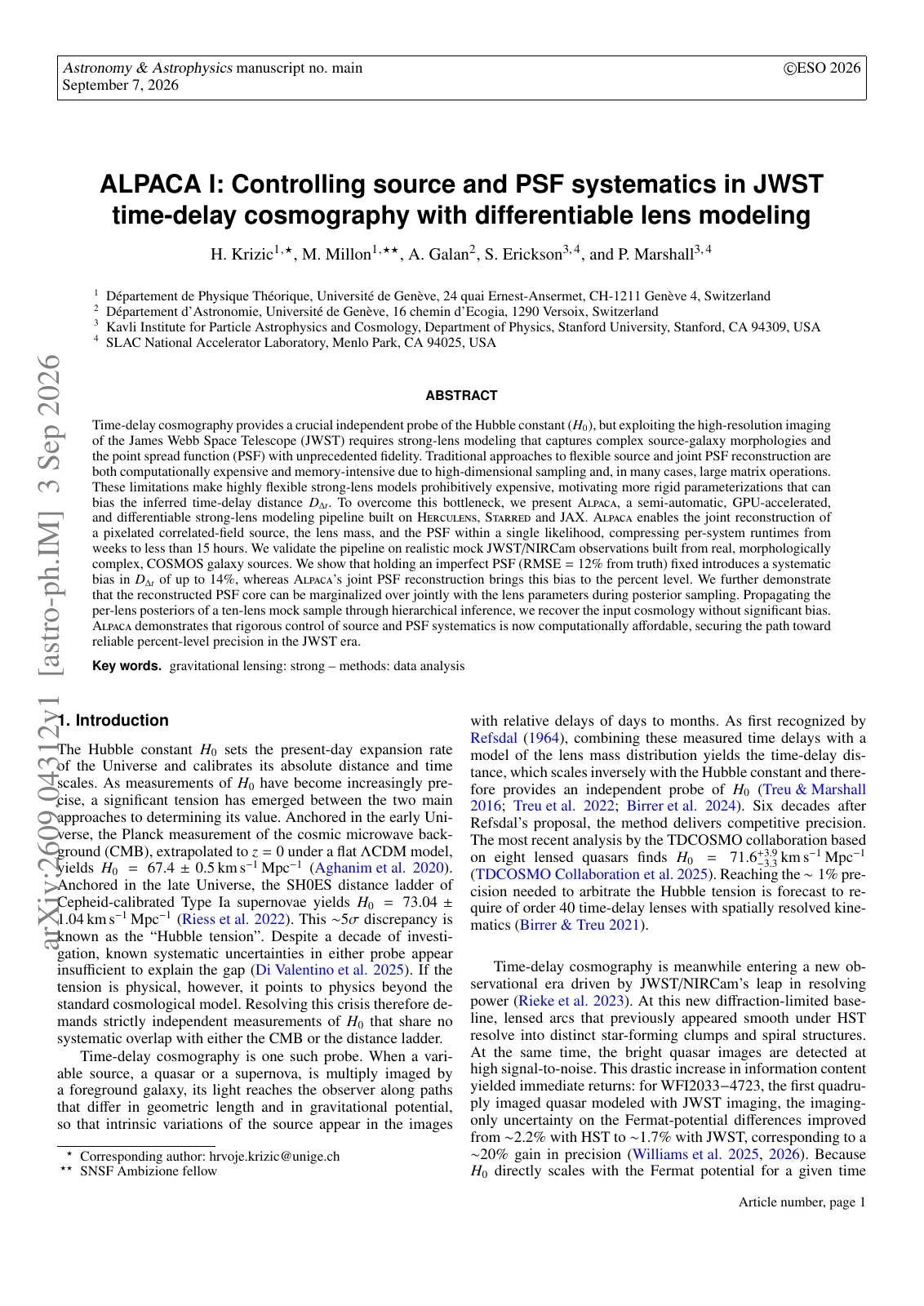
As part of my research, I am developing ALPACA (Automated Lens-modelling Pipeline for Accelerated TDCosmography Analysis), a JAX-based Python package that automates the full lens modeling workflow — from PSF reconstruction through gradient-descent optimization to Bayesian posterior sampling — enabling efficient, high-precision analysis of large lens samples.

Publications

Earlier research

Master ThesisSeptember 2024 – March 2025

Modeling Density Distributions in Ionized Regions in the Early Universe

Master Thesis

September 2024 - March 2025

Supervisors

  • Prof. Dr. Alexandre Refregier, ETH Zurich
  • Dr. Michele Bianco, ETH Zurich

Physics Department - Cosmology Group
ETH Zurich

In my master's thesis, I explore the application of AI to model and predict CDM density distributions inside ionized HII regions (bubbles) in the early universe.

The primary objective is to develop a flow-based generative model that takes a given ionized bubble as input and outputs a probabilistic density distribution of matter within that bubble. The model is trained using a dataset of bubble-density pairs, where each bubble corresponds to a 2D density slice extracted from high-resolution simulations using pyC2Ray. To achieve this, I employ normalizing flows (GLOW), which iteratively transform a simple base distribution into the target density distribution.

Semester ProjectJanuary 2024 – June 2024

Lunar Response to Gravitational Waves

Semester Project

January 2024 - June 2024

Supervisors

  • Prof. Dr. Philippe Jetzer, University of Zurich
  • Prof. Dr. Gian Michele Graf, ETH Zurich

Physics Institute - Gravitation and Astrophysics Group
University of Zurich

In this thesis, we review in detail the interaction between gravitational waves (GWs) and the Moon, treated as an elastic body. The aim is to combine theoretical findings with previous literature to make the topic more accessible.

Building on the theoretical framework of elasticity, we derive and linearize Cauchy's equations of motion to model the Moon's response to such a GW. By investigating toroidal and spheroidal oscillations induced by a GW in different polarizations, we derive the differential equation systems to predict the Moon's displacements, which can then be numerically solved.

Normal mode oscillation of the Moon caused by a gravitational wave
A normal mode oscillation of the Moon, caused by a gravitational wave.
ProseminarFebruary 2023 – June 2023

Three-String Interaction

Proseminar

February 2023 - June 2023

Supervisors

  • Prof. Dr. Matthias Gaberdiel, ETH Zurich
  • Dr. Matthew Lewandowski, ETH Zurich

Physics Department - String Theory Group
ETH Zurich

In this report, we explain how the world-sheet of a string can be viewed as a Riemann surface. This is essential when calculating quantum mechanical scattering amplitudes, which in string theory characterize the probability of different scattering occurring.

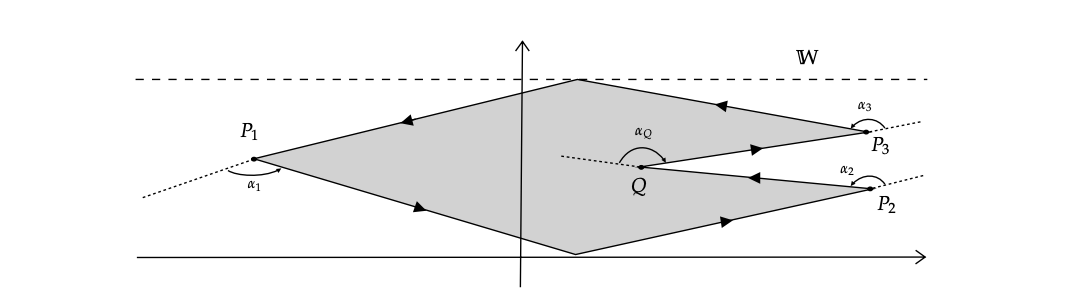
In order to map the upper half-plane of the complex plane onto a polygon, the Schwarz-Christoffel map is introduced. As a result, we can find a canonical representation of the world-sheet of three strings interacting by considering it as a degenerate polygon.

World sheet of a three string interaction as a degenerate polygon
Illustration of the idea to view the world sheet of a three string interaction as a degenerate polygon.
Laboratory Work2022

Muon Spin Rotation Study on Type-I Superconductivity

Laboratory Work

2022

Paul Scherrer Institute (PSI)
Villigen, Switzerland

Conducted a muon spin rotation study on Type-I superconductivity in lead (Pb) at the Paul Scherrer Institute laboratory. This experimental work provided hands-on experience with advanced particle physics techniques and superconductor characterization.

Gravitational lensing & lensed quasars

A foreground galaxy can produce several images of the same background object. These interactive examples use simplified lens models and simulated light curves.

Arcs and rings

A galaxy in front of a more distant source can bend its light into arcs. Change the source alignment or the lensing strength to see how the image changes.

β = θ − α(θ)

Illustrative model · Isothermal sphere + external shear
The lens equation

Lensed quasars

A quasar is the compact, bright centre of a galaxy. A foreground galaxy can split its light into several images, while the more extended light of its host galaxy is stretched into arcs. The two views below show the same source before and after lensing.

Drag the source (the cross) in the left view. Try moving it across the dashed caustic to see images appear, merge or disappear. You can also use the position sliders or the arrow keys when the source view has focus.

Source planeβ = (0.05, 0.02)″
CausticQuasarHost galaxy
Image plane−3″ … +3″
Critical curveQuasar imagesLens G

Calculating lens images…

Source

Host galaxy & brightness

Lens

Mass profile & environment

The density slope γ controls how concentrated the lens mass is. γ = 2 is isothermal. Shear stretches the pattern without adding a second galaxy.

With the satellite enabled, drag G1 in the image plane to move it.

Display

Image positions & magnifications
Imagex (″)y (″)|μ|Parity

|μ| is the brightness amplification of an ideal point source. Negative parity means a mirrored image. Labels are ordered by magnification.

The dashed caustic marks source positions at which the number of images can change. Near a fold, two images approach each other; near a cusp, three gather together. A faint additional image can lie elsewhere. The solid critical curve is the corresponding curve in the image plane.

The bright arcs are the quasar’s host galaxy, reconstructed by tracing each image pixel back to the source. Their shape constrains the lens mass. Changing the axis ratio makes the lens more or less elliptical; external shear represents the tidal influence of its surroundings.

This is an elliptical power-law lens with a Sérsic host and an optional satellite. The strength b equals the Einstein radius for a circular lens. The source view is enlarged by default. Marker sizes indicate relative magnification; the display uses a brightness stretch and does not model a telescope’s PSF or noise.

Measuring a time delay

Quasars vary in brightness. Each lensed image repeats the same variations, but at a different time because the light follows different paths through the gravitational field.

Shift the dashed curve earlier until its peaks match the solid curve. The required shift is the time delay between the images.

Image AImage B
Simulated curves, normalized in brightness. Real observations also contain noise and microlensing variations.

From time delays to cosmology

A time delay becomes a distance measurement when combined with a model of the lens mass and the matter along the line of sight. This is why accurate lens modeling matters: together with the measured delay, it helps constrain the Hubble constant.

More about time-delay cosmography

Point at or tap a galaxy: seen from any of them, all others move away, faster the farther they are. Scroll to let the universe expand.

Hubble’s law, v = H₀ d: the Hubble constant H₀ sets how fast the universe expands today. Measurements from the early universe (Planck, 67.4 km/s/Mpc) and from the local distance ladder (SH0ES, 73.0 km/s/Mpc) disagree. Time-delay lenses measure H₀ independently of both. Illustration, not data.